Tokyo – January 21, 2026 – TOPPAN Digital Inc. (TOPPAN Digital), a TOPPAN Group company and wholly owned subsidiary of TOPPAN Holdings Inc. (TYO: 7911), provides a range of IoT device security solutions. These include secure element Edge Safe™1 and Secure Activate Service™2 for communication between IoT devices and the cloud.
TOPPAN Digital has now equipped Edge Safe™ and Secure Activate Service™ with functions to support post-quantum cryptography (PQC), inhibiting the ability of quantum computers to crack encryption. Available from January 21, these IoT solutions can be used securely in the quantum computing age and will be targeted at manufacturers and industries managing the long-term use of IoT devices such as smart appliances, medical devices, and equipment for manufacturing and infrastructure.
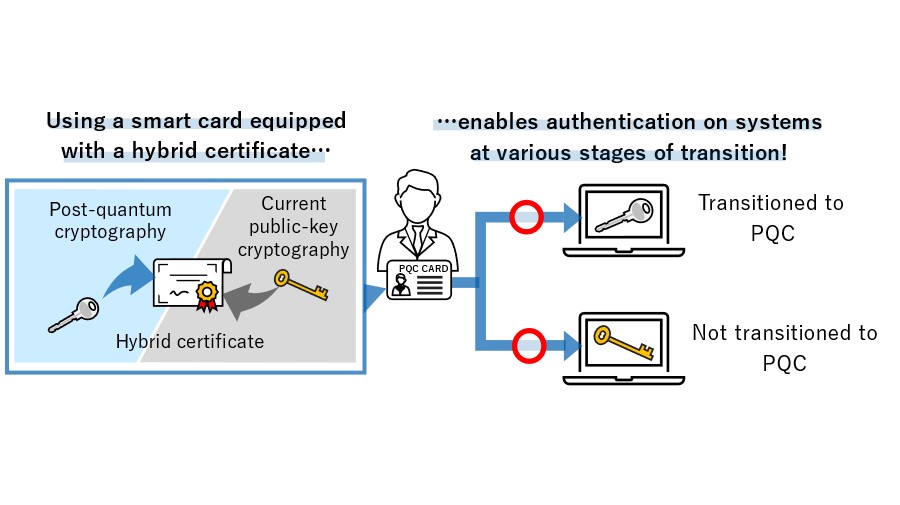
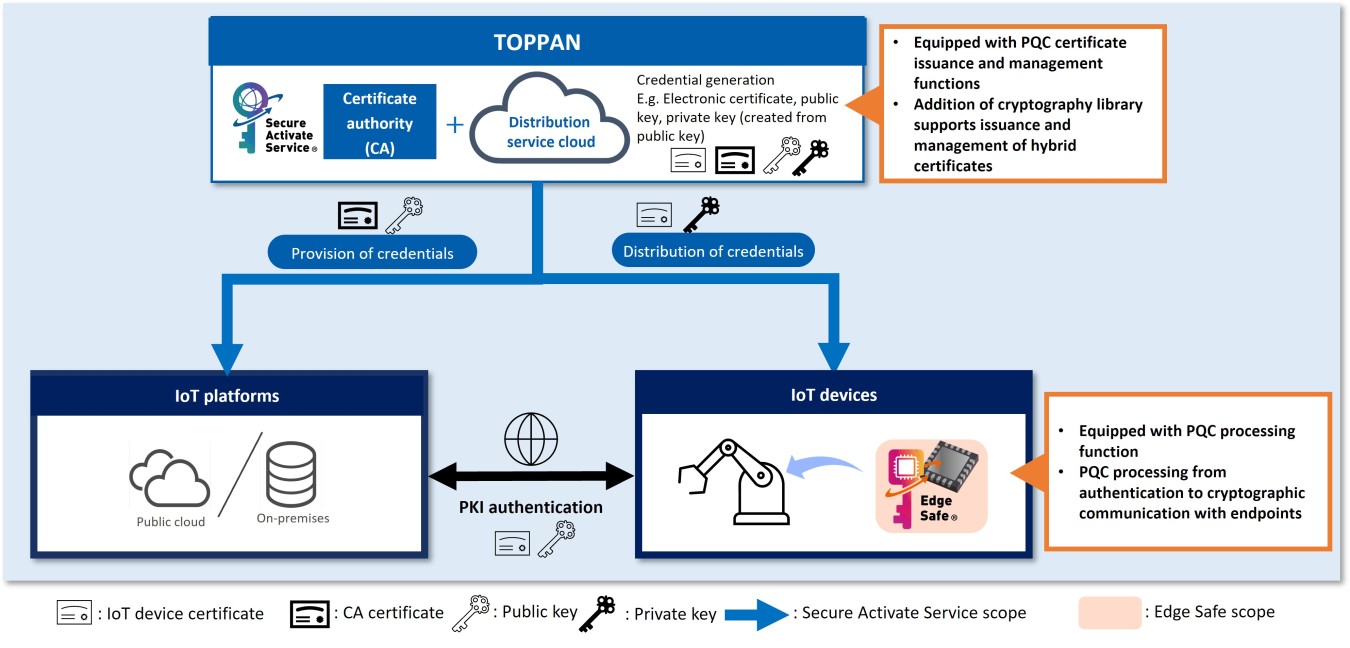
Edge Safe™ is a secure element embedded in IoT devices. In addition to authentication using current cryptography, Edge Safe™ has now been equipped with PQC processing capabilities. This allows PQC to be employed at every stage from authentication to cryptographic communication between IoT devices and endpoints. Meanwhile, Secure Activate Service™ facilitates secure communication between IoT devices and the cloud. The addition of hybrid certificates supporting both current and quantum-resistant cryptography facilitates a secure and phased migration to PQC while also enabling the continued use of existing crypto-assets.
With PQC capabilities now added to these TOPPAN Digital solutions, it will be possible to employ hybrid methodology delivering end-to-end support for both current cryptography and PQC across all processes from IoT device authentication to communication. This will ensure long-term IoT device security in preparation for the widespread use of quantum computing as well as supporting the transition to PQC with reduced risk.
Background to Development
Current public-key cryptography3 used for internet-based services could be vulnerable to attacks by quantum computers in the future. The U.S. National Institute of Standards and Technology (NIST) is therefore advancing the standardization of PQC while accelerated efforts focused on security are being seen throughout the world. IoT devices used over long periods are potentially subject to multiple threats, including interception or tampering that targets encryption keys and certificates, as well as the risk of harvest attacks4 in the future. This makes it essential to ensure both long-term security and sufficient crypto-agility to allow for secure and concurrent use of both conventional and next-generation cryptographies for a successful migration to PQC. In response to changes in the security landscape, TOPPAN Digital has pursued development of PQC- compatible smart card systems and testing of network environments. The expertise and insights gained have now been leveraged to equip Edge Safe™ and Secure Activate Service™ with PQC support functions that provide protection covering the stages from IoT device authentication to communication. TOPPAN Digital’s aim is to support a smooth transition to PQC by providing infrastructure for the continued use of IoT services in the quantum computing age.
PQC Support Functions of Edge Safe™ and Secure Activate Service™
To deliver end-to-end PQC support, TOPPAN Digital has equipped Edge Safe™ with processing capabilities for NIST-selected PQC algorithms and integrated hybrid certificate issuance and management into Secure Activate Service™.
・ Edge Safe™: Unified processing of current cryptology and PQC
Edge Safe™ is a security chip that provides physical protection for encryption keys. It prevents unauthorized operation when embedded in factory robots, infrastructure, and other IoT devices. The addition of new functions means that Edge Safe™ is now equipped to handle processing of not only current cryptography but also PQC. The algorithms applied are ML-DSA (digital signatures) and ML-KEM (key exchange), both of which have been selected by NIST as cryptography technologies that ensure long-term security. This makes it possible to process both current cryptography and PQC methodologies on Edge Safe™, covering every part of the flow from authentication to cryptographic communication between IoT devices and endpoints.
・ Secure Activate Service™: Supporting issuance and management of current digital certificates, PQC certificates, and hybrid certificates
Secure Activate Service™ issues digital IDs to prevent spoofing by rogue devices when smart appliances or medical devices connect to manufacturers’ cloud services. In addition to the current digital signature required for authentication, a PQC certificate issuance function has now been added, making it possible to implement a phased migration to PQC certificates while also using current ones. The service will contribute to a secure and smooth transition to PQC by also supporting hybrid certificates compatible with both current and quantum-resistant cryptography.
Future Activities
TOPPAN Digital will market the PQC-ready Edge Safe™ and Secure Activate Service™ to a broad range of industries handling IoT devices while continuing to support prompt PQC migration for IoT security infrastructure in Japan and contributing to a safe and secure digital society into the quantum computing age.
A security chip (secure element) embedded into IoT devices to physically protect encryption keys. In contrast to conventional memory, it functions as a robust vault that prevents unauthorized data extraction via disassembly or analysis. Even if factory robots or components of infrastructure are stolen and disassembled, the secure element protects the essential key information inside to prevent unauthorized operation.
2. Secure Activate Service™
A platform for issuing and managing digital IDs (digital certificates) that authenticate the legitimacy of IoT devices connecting to the cloud. The digital IDs issued prevent spoofing by rogue devices when smart appliances or medical devices connect to the cloud servers of manufacturers.
3. Public-key cryptography
A cryptography methodology that uses a pair of keys (a public key and a private key) for data encryption and digital signatures. Current algorithms include RSA and ECDSA.
4. Harvest attack
A type of cyber-attack in which the attacker intercepts and accumulates encrypted data with the intention of decrypting it at a point in the future when high-performance quantum computers are available.
About the TOPPAN Group
Established in Tokyo in 1900, the TOPPAN Group is a leading and diversified global provider committed to delivering sustainable, integrated solutions in fields including printing, communications, security, packaging, décor materials, electronics, and digital transformation. The TOPPAN Group’s global team of more than 50,000 employees offers optimal solutions enabled by industry-leading expertise and technologies to address the diverse challenges of every business sector and society and contribute to the achievement of shared sustainability goals.
https://www.holdings.toppan.com/en/
https://www.linkedin.com/company/toppan/