
EnvironmentEnvironmental Policy and Targets
Basic ApproachBack to Top
With growing awareness of environmental conservation throughout the world in the 1990s, the scope of environmental issues to be tackled by businesses grew significantly. TOPPAN reorganized the framework for environmental conservation by establishing the Ecology Center in 1991 and formulating a Declaration on the Global Environment, a basic philosophy for environmental conservation activities, in 1992.
In April 2009 we revised this declaration into the TOPPAN Group Declaration on the Global Environment, an environmental action philosophy for the entire Group.
The TOPPAN Group Declaration on the Global Environment
As responsible members of international society, we who work within the TOPPAN Group strive to realize a sustainable society through forward looking corporate activities with consideration for the conservation of the global environment.
Basic Principles
- 1.
- We observe all laws, regulations and in-company rules relating to the environment.
- 2.
- For the future of the Earth, we strive for the effective utilization of limited resources and the reduction of all types of environmental burden.
- 3.
- With foresight, we promote the development and widespread use of products that show consideration for the environment, and contribute to the environmental activities of customers.
- 4.
- We engage in communication related to the environment with a wide range of peoples both inside and outside the company, and strive for mutual understanding.
- 5.
- We also take a proactive approach to environmental conservation in corporate activities in international society.
Formulated in April 1992
Revised in October 2023
TOPPAN Group Environmental PolicyBack to Top
In April 2024 we formulated a TOPPAN Group Environmental Policy as a replacement to the Annex to the TOPPAN Group Declaration on the Global Environment. This policy sets forth the environmental issues to address, our commitments, and systems and initiatives for implementation for the creation of a sustainable society as advocated in the declaration. Under this policy, we will deploy solutions to global environmental issues as means of enhancing our corporate value and shaping a sustainable society.
TOPPAN Group Environmental Policy
1. Environmental Issues to Address
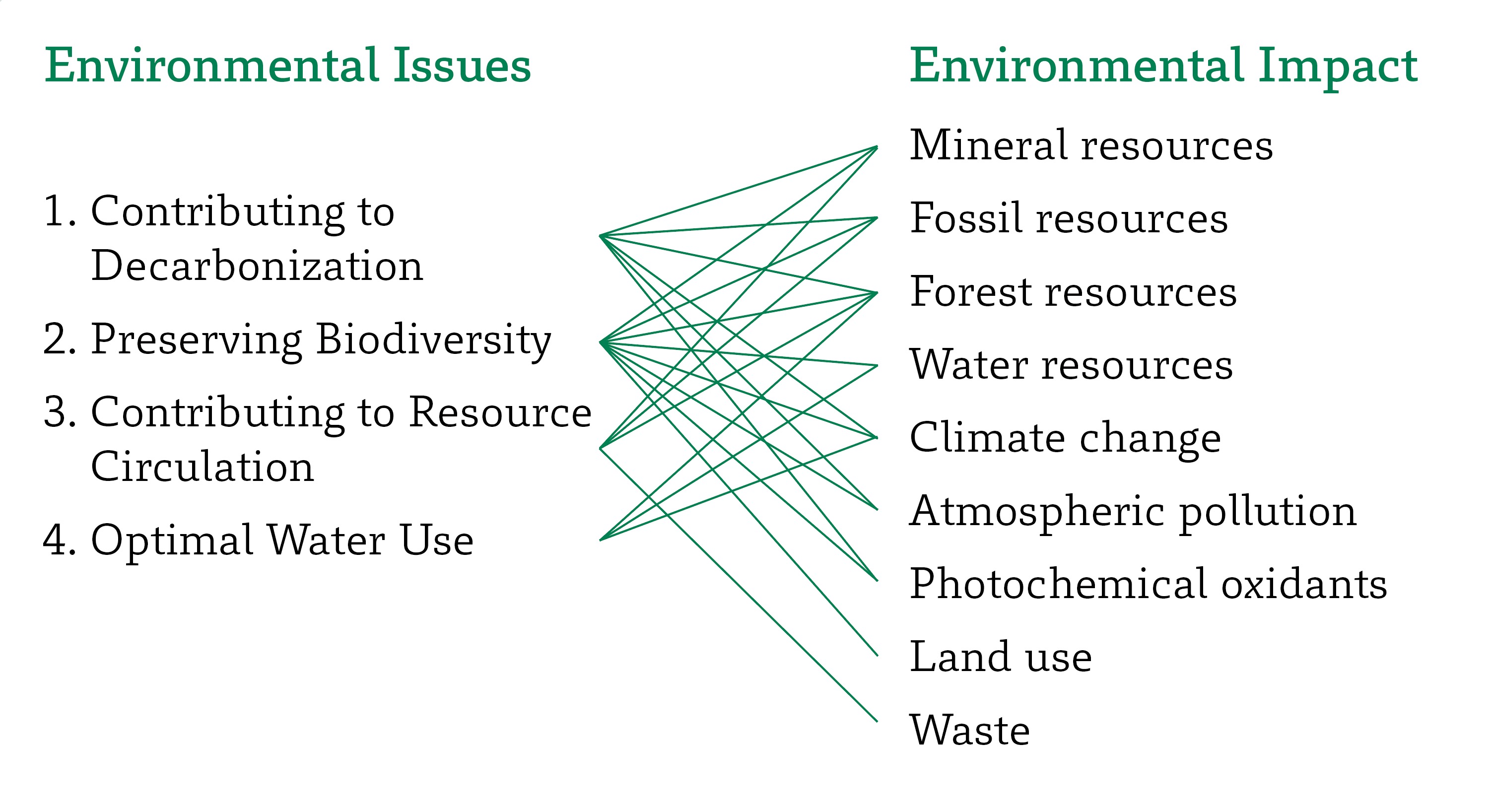
The TOPPAN Group uses life-cycle assessment (LCA) to identify environmental issues based on the environmental impact of its business activities.
Click to enlarge
Environmental Issues
- 1)
- Contributing to Decarbonization: Working to tackle climate change, conserve forest resources, and reduce fossil resource consumption.
- 2)
- Preserving Biodiversity: Working to conserve forest and water resources and prevent pollution.
- 3)
- Contributing to Resource Circulation: Working to ensure the circular use of fossil, forest, and mineral resources.
- 4)
- Optimal Water Use: Working to optimize water consumption, recharge water by conserving forest resources, and prevent pollution.
2. Commitments
1. Scope
We advance initiatives and collaboration focused not only on our own business
activities but on the entire value chain. This includes production activities and business
facilities, products and services, distribution and logistics, waste management, suppliers,
service providers, contractors, and other major business partners (businesses outside of our
control, joint venture partners, licensees, subcontracting partners, etc.), due diligence,
mergers, and
acquisitions.
2. Legal Compliance
In conducting our business activities, we comply with laws, regulations,
and other requirements related to environmental conservation.
3. Environmental Conservation and Pollution Prevention
In conducting our business
activities, we will strive to prevent pollution of the atmosphere, water, and soil; control water
consumption; and protect the environment to ensure the provision of sanitary water to employees
and local residents.
4. Measures to Address Climate Change
We will strive to achieve net zero by reducing
greenhouse gas emissions in our business activities and through the products and services we
provide.
5. Preservation of Natural Capital and Biodiversity
In conducting our business activities,
we will strive to achieve a net-positive impact on biodiversity, preserve natural capital, and
consider the human rights of local residents in procurement.
6. Deforestation Prevention
We will strive to achieve zero deforestation associated with
forest resources in paper procurement by 2025.
7. Product Stewardship
We will strive to minimize environmental risks throughout the
product life cycle and promote sustainable consumption.
8. Continuous Improvement
To fulfill our commitments, we will make continuous
efforts to improve our environmental management system, environmental vision and targets, and
relationships with internal and external stakeholders.
3. Systems and Initiatives for Implementation
1. Environmental Management System
Our environmental management system is structured based on ISO 14001. Environmental management
systems based on ISO 14001 drive improvements through a PDCA cycle of planning, support and
operation, assessment, and improvement. In addition, the Ecology Center, which is the organization
responsible for overseeing environmental conservation activities, monitors, checks, and audits
environmental performance data and legal compliance to ensure continuous improvement.
2. Governance
The Board of Directors of TOPPAN Holdings Inc. is the highest level body responsible for the
TOPPAN Group’s environmental conservation activities. As the organization that oversees
environmental conservation activities, the Ecology Center advances efforts under the direction of
an officer appointed by the Board of Directors, supervises and assesses activities, and reports
the results of verification to the Board of Directors. By supervising and providing guidance on
the
approval and progress of the TOPPAN Group Environmental Policy, the TOPPAN Group Environmental
Vision, and the TOPPAN Group Medium-and-Long-Term Environmental Targets, the Board of Directors
advances initiatives focused on key environmental issues for management, such as countermeasures
to climate change and preservation of natural capital.
3. Environmental Vision and Targets
To drive solutions to environmental issues, we will formulate a long-term environmental vision as
well as medium-term environmental targets that serve as milestones and will advance initiatives to
achieve the targets.
4. Raising the Awareness of Internal and External Stakeholders
We will contribute to solutions to environmental issues by disclosing information on the TOPPAN
Group’s environmental initiatives—including our declaration on the global environment,
environmental policies, performance data, and the progress of our efforts—and communicating with
internal and external stakeholders based on the information disclosed.
5. Employee Education
To drive solutions to environmental issues, we will provide TOPPAN Group employees with
educational opportunities that enable them to acquire and put into practice the necessary
knowledge on the environment.
Formulated in April 2024
Revised in April 2025
Environmental TargetsBack to Top
TOPPAN Group Environmental Vision 2050
We pledge our ongoing commitment to addressing environmental issues throughout the supply chain in cooperation with the communities we work with around the world. To accelerate the Group’s initiatives for a sustainable society that supports all forms of life in the global ecosystem of tomorrow, we have added preserving biodiversity and aiming for net zero Scope 3 greenhouse gas emissions to the TOPPAN Group Environmental Vision 2050 (“Vision 2050”). Vision 2050 is the long-term environmental policy we established in 2021.
TOPPAN Group Environmental Vision 2050
As a member of international society, the TOPPAN Group aims to enable “fulfilling, sustainable living” by contributing to decarbonization, preservation of biodiversity, resource circulation, and the optimal use of water through forward-looking activities with consideration for preservation of the global environment.
- 1.
- Contributing to Decarbonization
Aiming for net zero Scope 1 & 2 and Scope 3 greenhouse gas emissions. - 2.
- Preserving Biodiversity
Aiming for a society that coexists in harmony with nature, balancing conservation with socioeconomic activity. - 3.
- Contributing to Resource Circulation
Aiming for zero waste emissions. - 4.
- Optimal Water Use
Contributing to achieving optimal water use and improving water quality by preventing pollution.
TOPPAN Group Environmental Targets for 2050
To achieve the TOPPAN Group Environmental Vision 2050, we have set the following targets, with fiscal 2017 as the benchmark year and 2050 as the deadline for achieving the targets.
- 1.
- Contributing to decarbonization
Scope 1 & 2 greenhouse gas emissions: Net zero (90% reduction compared to fiscal 2017*; based on a 1.5° scenario)
Scope 3 greenhouse gas emissions: Net zero (90% reduction compared to fiscal 2017*)
- *
- Offsetting residual emissions using internationally recognized methods
TOPPAN Group Medium-and-Long-Term Environmental Targets for Fiscal 2030
- 1.
- Contributing to decarbonization
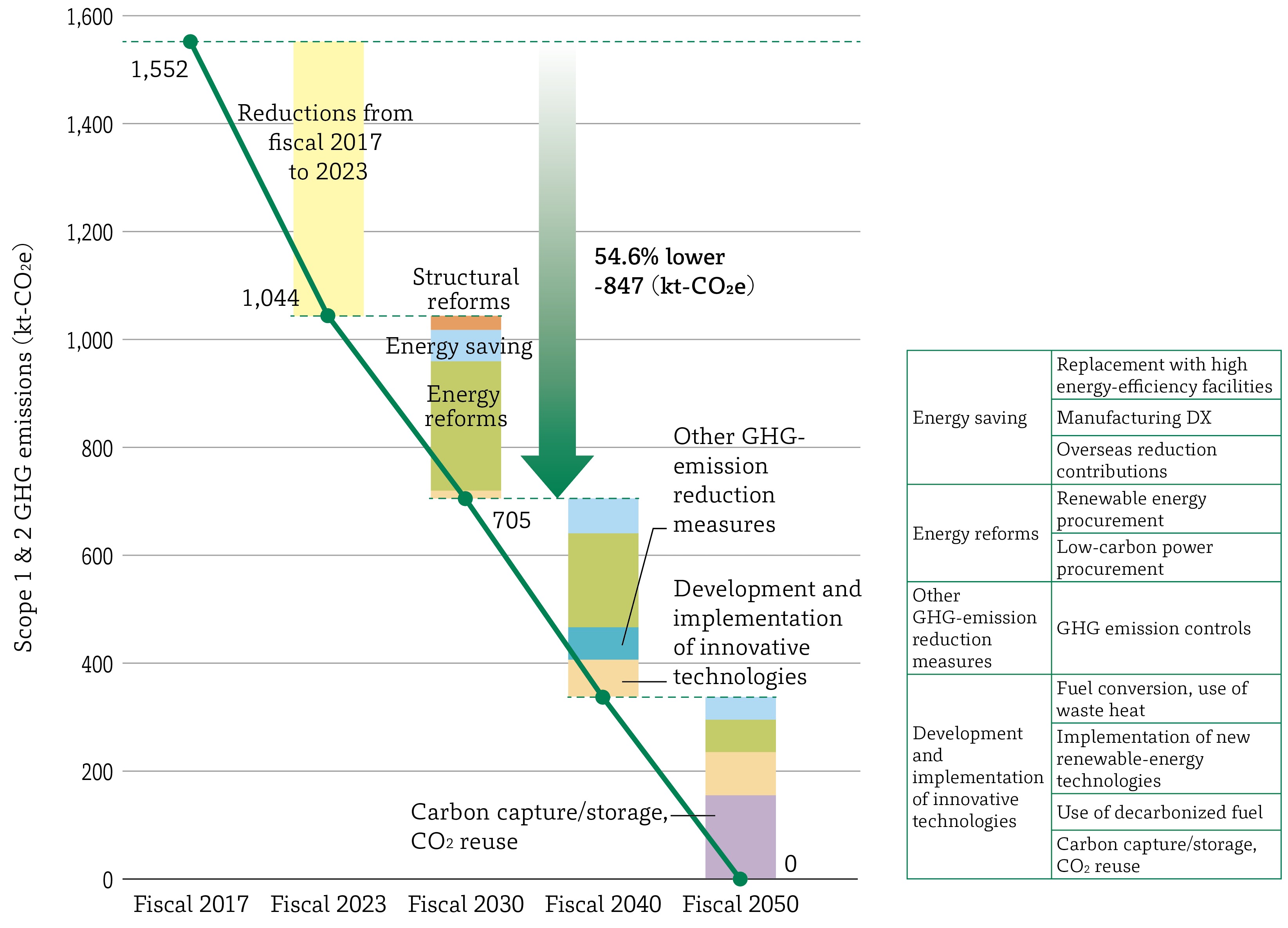
Reduce Scope 1 & 2 greenhouse gas emissions by 54.6% compared to fiscal 2017 (renewable energy ratio of 25%; based on a 1.5° scenario).
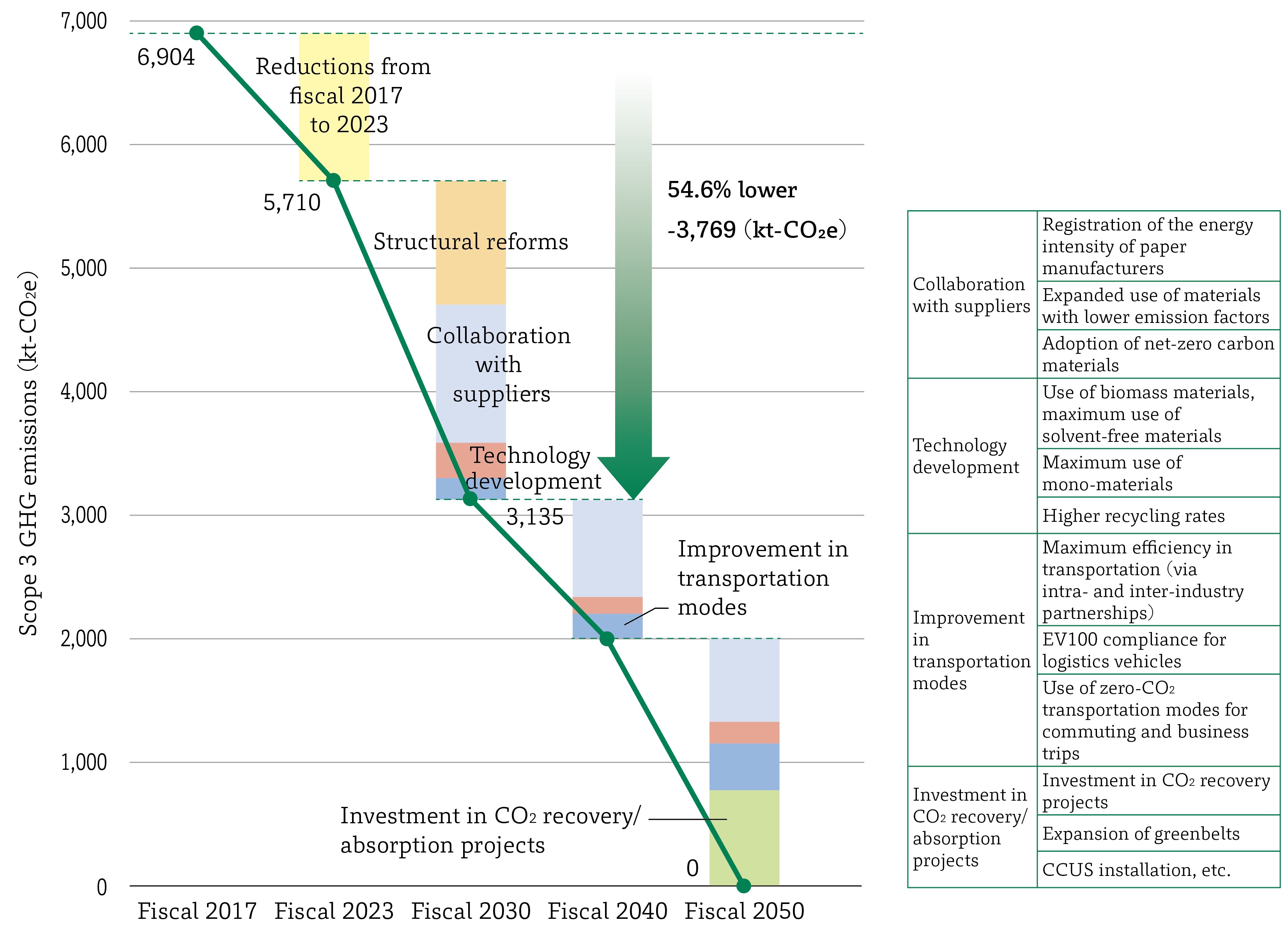
Reduce Scope 3 greenhouse gas emissions by 54.6% compared to fiscal 2017 (based on a 1.5° scenario). - 2.
- Preserving biodiversity
Confirm 100% legality in procurement of paper raw materials by fiscal 2025.
Contribute to the conservation of regions in which humans coexist with nature both inside and outside the Group, covering an area equivalent to 10% of the total area of manufacturing sites. - 3.
- Contributing to resource circulation
Reduce final landfill waste disposal by 60% compared to fiscal 2017.
Increase waste plastic material recycling rate by 9 percentage points compared to fiscal 2017. - 4.
- Optimal water use
Achieve water withdrawal reduction targets for at least 50% of sites (4 sites) with high water risk (water stress exceeding 40%; total of 7 sites).
Ensure no cases of action taken by authorities due to exceeding regulatory threshold values.
Greenhouse Gas Reduction Targets Validated by SBT
TOPPAN Holdings has obtained Net-Zero Target validation from the Science Based Targets initiative (SBTi) for greenhouse gas emission reduction targets across the entire TOPPAN Group value chain.
For emissions that still cannot be fully reduced even through reduction efforts aligned with the 1.5°C emission pathway, we aim to achieve net zero by developing and introducing innovative technologies and making investments to utilize means such as forest-derived absorption and carbon removal technologies.
| Overall Net-zero Target | 2050 target Net-zero Scope 1 & 2 and Scope 3 GHG emissions |
|---|---|
| Near-term Targets | 2030 targets Scope 1 & 2 GHG emissions: Reduce by 54.6% compared to the fiscal 2017 level Scope 3 GHG emissions: Reduce by 54.6% compared to the fiscal 2017 level |
| Long-term Targets | 2050 targets
Scope 1 & 2 GHG emissions: Reduce by 90% compared to fiscal 2017 level Scope 3 GHG emissions: Reduce by 90% compared to fiscal 2017 level |
Transition Plan for Carbon Neutrality by 2050
Scope 1 & 2
By 2030, the TOPPAN Group will focus on energy efficiency measures and the preferential adoption of low-carbon power and renewable energy sources.
From 2030, we will switch fuel sources and increase the use of decarbonized fuel.
By current estimates, approximately 10% of the Scope 1 & 2 greenhouse gas (GHG) emissions resulting from our operations in fiscal 2017 will still be emitted in 2050. These emissions will be absorbed using carbon capture/storage technologies, CO2 reuse technologies, and other carbon neutrality measures deployed to achieve net zero emissions by 2050.
Click to enlarge
Scope 3
By 2030, TOPPAN will further adopt low-carbon materials and switch from paper to digital data through the digital transformation (DX).
From 2030, we will adopt low-carbon logistics companies outside of the Group and shift from fossil fuels to electricity to power vehicles owned by logistics companies within the Group.
By current estimates, approximately 10% of the Scope 3 GHG emissions resulting from our operations in fiscal 2017 will still be emitted in 2050. We will absorb these emissions by investing in CO2 recovery projects and expanding greenbelts to achieve net zero emissions by 2050.
Click to enlarge
- *
- GHG emissions quantification is subject to uncertainty when measuring activity data, determining emission factors, and considering scientific uncertainty inherent in the Global Warming Potentials.
Single-year Environmental Targets
The Ecology Center aggregates annual environmental performance data related to targets set under the fiscal 2030 goals, reports results to the Board of Directors, sets single-year targets, and develops measures for the current year with authorization from the Board of Directors. Site-specific targets set in line with the Groupwide targets are treated as key performance indicators for managing the progress of environmental conservation activities carried out at individual sites.
Environmental Targets for Fiscal 2025
| Performance Target | Performance Indicator | Target Value for Fiscal 2025 | |
|---|---|---|---|
|
Reduce CO2 emissions | Scope 1 & 2 greenhouse gas emissions | 874 kt-CO2e |
| Renewable energy ratio | 10.0% | ||
| Scope 3 greenhouse gas emissions | 5,323 kt-CO2e | ||
|
Prevent illegal deforestation | Confirm the legality of raw materials procured for paper production | 100% |
| Contribute to a society that coexists in harmony with nature | Area of land in which humans coexist in harmony with nature | Increase by one the number of regions contributing to conservation in which humans coexist in harmony with nature | |
|
Reduce final landfill waste disposal | Final landfill waste disposal | 4,300 t |
| Circulate resources | Waste plastic material recycling rate | 56.8% | |
|
Set medium- and long-term water consumption targets for the TOPPAN Group (considering other environmental impacts) |
||
| Prevent water pollution | No. of actions taken by authorities in response to exceeded regulatory standards | 0 | |
Environmental Policy and Targets
- Data
- ● TOPPAN Group Medium-and-Long-Term Environmental Targets for Fiscal 2030 (Fiscal 2024 Results)
- Assessing Environmental Impact
- ● Quantifying Environmental Impact based on LIME